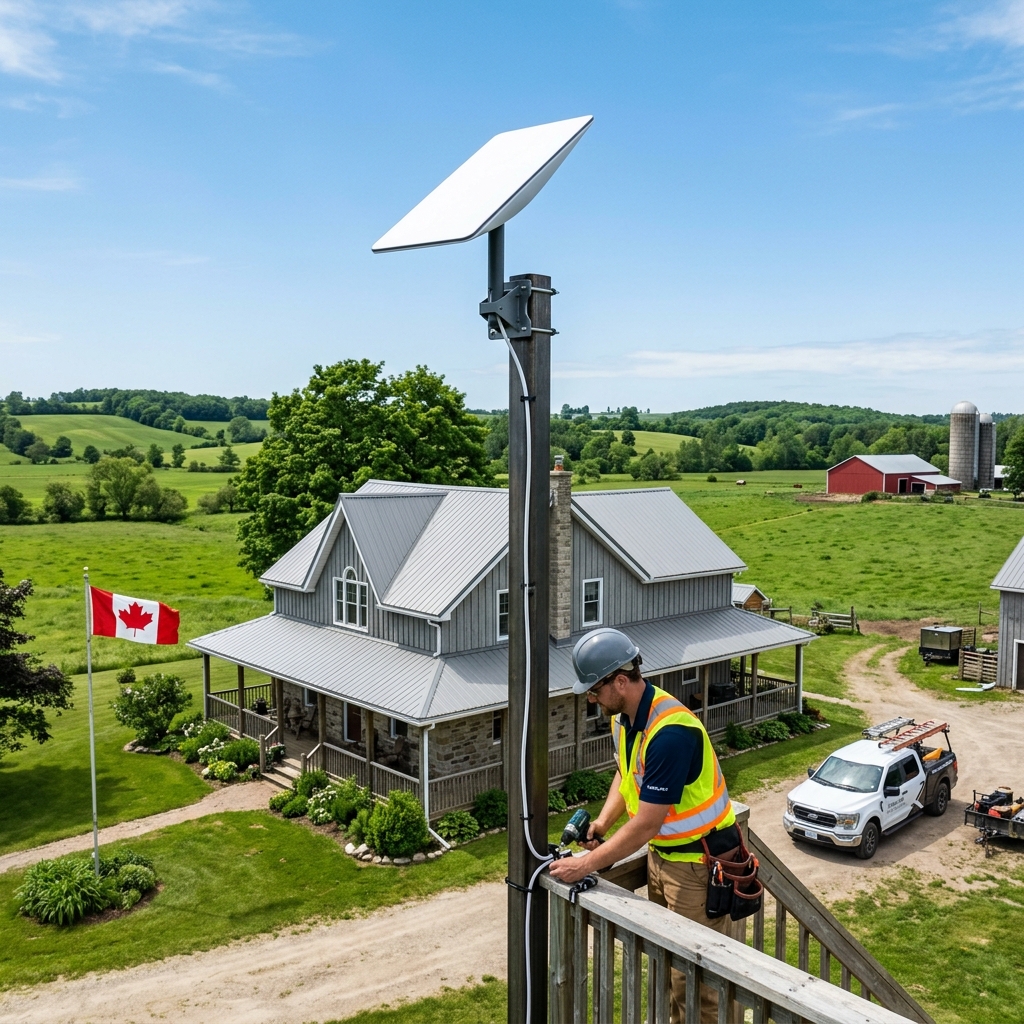
If you live outside the reach of cable or fibre in Caledon, Orangeville, Erin, Arthur, or anywhere in Dufferin or Wellington County, you already know the problem: DSL that crawls, fixed wireless that drops every time it rains, or a "high-speed" plan that tops out at 10 Mbps. Starlink has become the go-to fix for rural Ontario properties like these — but a dish thrown on a fence post doesn't get you the speeds Starlink is capable of. Getting full performance out of it depends almost entirely on where and how it's installed.
SmartAura installs Starlink systems for homes and farms across Caledon, Orangeville, Erin, Arthur, Grand Valley, Shelburne, Mono, Hillsburgh, Belfountain, Alton, Terra Cotta, Mansfield, and the rest of Dufferin and Wellington County. This guide covers what the installation actually involves, why location matters more than people expect, and what to check before you book someone.
Why Rural Properties Around Orangeville and Caledon Are Switching to Starlink
Broadband expansion has been slow to reach this part of Ontario. Caledon's own broadband project with Rogers wasn't expected to reach every household until the end of 2025, and many properties in Dufferin County and rural Wellington still sit outside any fibre or cable footprint entirely. For a lot of homeowners here, the realistic choices are DSL, fixed wireless, cellular hotspots, or satellite — and Starlink is usually the fastest and most consistent of that group, especially on larger rural lots where trees, barns, or rolling terrain get in the way of fixed wireless towers.
The trade-off: Starlink's performance is entirely dependent on a clear, obstruction-free view of the sky. A dish mounted in the wrong spot — too close to a tree line, on the wrong roof slope, or shadowed by a barn — will drop out constantly no matter how good your plan is. That's the part a professional install actually solves.
Towns and Areas We Install Starlink In
We regularly install and service Starlink systems in:
- Caledon — including Palgrave, Alton, Belfountain, Terra Cotta, and Caledon East
- Orangeville
- Erin and Hillsburgh
- Arthur
- Grand Valley
- Shelburne
- Mono
- Amaranth and East Garafraxa
- Mansfield and Mulmur
- Surrounding rural properties throughout Dufferin County and Wellington County
If your property is on a large rural lot, a farm, or a hobby acreage anywhere in this region, this is exactly the kind of install we do most.
What a Professional Starlink Installation Includes
1. Site Survey
We use the Starlink app's obstruction data plus an on-site check to find the true best mounting location, accounting for tree growth, seasonal sun angle, and nearby structures.
2. Mount Selection
Roof mount, pole mount, or ground mount depending on your property. Farms and larger acreages often do better with a pole mount away from the house entirely, run back by buried or concealed cable.
3. Cable Routing
Clean entry into the home, concealed where possible, protected from weather and rodents in outbuildings/barns.
4. Router Placement & Mesh WiFi Integration
Connecting Starlink into a whole-property mesh system so a farmhouse, detached garage, or barn office all get reliable coverage instead of one weak signal near the router.
5. Testing
Confirming sustained speeds and checking for intermittent obstruction drops across different times of day.
How to Tell Whether Your Property Will Get a Clear Signal
Starlink needs an unobstructed view of a wide cone of northern sky, and on a rural lot the thing that blocks it is almost always mature trees rather than buildings. The mistake we see most often is a dish mounted at roof height on a farmhouse with a maple line along the lane: it works in winter, then degrades in May when the canopy fills in. Obstructions do not usually announce themselves as an outage — they show up as a call that drops for four seconds, repeatedly, at the same time of day.
Before committing to a mounting position we check the sky view from several candidate points, because on most properties there is somewhere that works even when the house itself does not. Sometimes that is a pole set out in the open away from the building. Sometimes it is the peak of a shop roof rather than the house. Knowing this before hardware is ordered is the difference between a system that performs and one that gets blamed on the satellite.
Pole Mounts, Cable Runs and Grounding on an Exposed Lot
Once the dish moves off the house, the cable becomes the job. Starlink’s supplied cable has a fixed length, so a dish a hundred feet out needs outdoor-rated, direct-burial Ethernet from a weatherproof enclosure at the pole back to the building. On an open rural lot that run also needs proper grounding and surge protection at both ends. This is not optional detail: an exposed property in Dufferin or Caledon takes storm activity that a house in a subdivision does not, and an ungrounded run is the most common way a working system dies in July.
Pole height gets sized to clear the tree line with margin for another decade of growth, and anchoring gets sized for open-field wind exposure rather than sheltered suburban conditions. Both of those cost a little more up front and save a return visit.
Getting Coverage Out to Barns, Shops and Second Buildings
Rural properties are rarely one building, and the part most self-installs leave unfinished is everything past the house. A working shop, a barn, a garage or a secondary dwelling needs usable coverage, not a single bar leaking through a steel wall. Depending on distance and line of sight, we either run buried cable between buildings or install a point-to-point wireless bridge, then put an access point inside the far building so the signal is actually usable at the bench.
Steel-clad structures matter here. Metal siding and roofing are effective at blocking Wi-Fi, so a shop that seems close enough to reach from the house almost never is. Treating it as its own coverage zone from the start is cheaper than discovering it afterward.
Winter Considerations
Ontario winters affect the install more than the service. Wall pass-throughs need to be sealed for freeze-thaw cycling rather than just weather, and mounting position needs to account for ice and snow sheeting off a steep metal roof — a dish or a cable in that path will not survive a thaw. The dish itself handles snow through its own heating, but that only helps if it was mounted somewhere the snow can actually shed.
Frequently Asked Questions
Do you install Starlink in Caledon and Orangeville?
Yes. SmartAura installs Starlink throughout Caledon, Orangeville, and the surrounding Dufferin County area, including rural properties and farms.
Do you install Starlink in Erin, Arthur, or Grand Valley?
Yes, we regularly install Starlink in Erin, Hillsburgh, Arthur, Grand Valley, Shelburne, and the wider Wellington County area.
Book a Site Survey
If you're in Caledon, Orangeville, Erin, Arthur, or anywhere in Dufferin or Wellington County and dealing with unreliable rural internet, we can assess your property and recommend the right Starlink setup. Book a free consultation or call us to get started.