Quick answer: Run a cable if you can. Buried outdoor Ethernet works up to 100 metres, and fibre goes further. If you cannot trench, a point to point wireless bridge with clear line of sight does the job. Either way, put an access point inside the second building. Mesh nodes and plug-in extenders rarely reach, especially into steel buildings.
One Starlink dish can serve every building on your property. The dish is not the hard part. Getting a solid connection from the house to the barn, shop, garage or second home is. It is the part most self-installs leave unfinished, and it is a regular part of our rural Starlink installations and home networking work.
Why the Wi-Fi From the House Does Not Reach
Home Wi-Fi is built to cover one building. It loses strength through every exterior wall and across every metre of open yard. Steel siding and steel roofing block it almost completely, so a shop that looks close enough almost never is.
The fix is to stop thinking of it as stretching the house Wi-Fi. Treat each building as its own coverage zone, and carry the internet to it properly.
Option 1: Buried Ethernet Cable
This is the most reliable choice when the buildings are close. Outdoor rated, direct burial Ethernet goes in a trench, ideally inside conduit so it can be replaced later without digging.
- The limit is 100 metres (328 feet) per cable run.
- You get the full speed of your Starlink at the far end.
- Copper between two buildings carries lightning energy as well as data, so the run needs grounding and surge protection at both ends.
Option 2: Fibre Between Buildings
Fibre is the answer for long runs and exposed sites. Glass does not conduct electricity, so a strike near one building cannot travel along the cable to the other. Distance stops being a concern at farm scale.
It needs a small converter at each end and costs a little more than copper. On a long run across an open lot, it is usually worth it.
Option 3: Point to Point Wireless Bridge
A wireless bridge is a pair of small outdoor radios, one on each building, aimed at each other. Think of it as an invisible cable.
- It needs clear line of sight. Trees between the buildings will weaken or break the link, and a path that is clear in March can be blocked in June.
- It crosses driveways, laneways and yards you cannot trench.
- It can cover several hundred metres when the path is clear.
A bridge only gets the signal to the outside wall. You still need a cable into the building and an access point inside.
We build these links with Ubiquiti UniFi and TP-Link Omada equipment, and our recent building to building jobs have used Ubiquiti's Wave Pico radios.
What About Mesh Nodes and Extenders?
They can work for a wood frame garage right beside the house. Between separate buildings they usually disappoint. A node can only repeat what it hears, and every wireless hop costs speed. Through steel, they do not work at all. Inside a single house the trade-offs are different, and we cover them in wired access points vs mesh Wi-Fi.
Always Finish With an Access Point Inside
Whatever carries the internet to the second building, put an access point inside it. In a metal shop or barn this is not optional. The signal has to start on the inside of the steel.
Which Option Fits Your Property
| Your situation | Best option |
|---|---|
| Under 100 metres and you can trench | Buried Ethernet |
| Over 100 metres, or an open site exposed to storms | Fibre |
| Cannot trench, clear view between buildings | Wireless bridge |
| Wood frame garage beside the house | A mesh node may be enough |
| Metal building of any kind | Cable or bridge, plus an access point inside |
Three Things Specific to Starlink
You do not need a second dish. One Starlink can feed a second building on the same property through a cable or a bridge.
Check your router for Ethernet ports. Newer Starlink routers have them built in. Older ones need Starlink's Ethernet adapter before anything can be wired to them.
The router does not have to live in the house. Sometimes the best view of the sky is at the barn or the shop. The dish and router can go there, as long as the spot is dry and powered, and the house becomes the second building.
From the Field: One Dish, Two Buildings, 500 Metres Apart
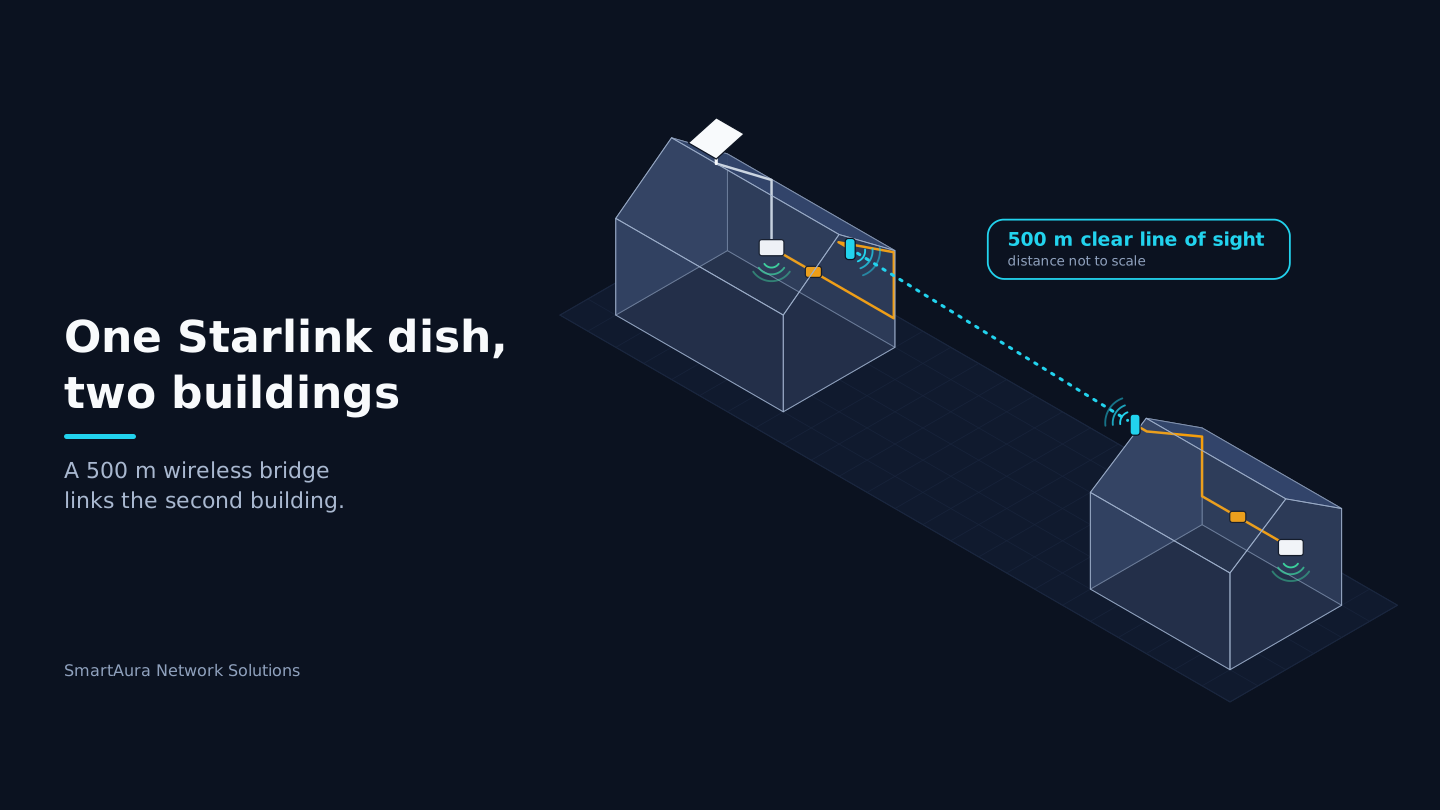
On a recent job, the two buildings sat 500 metres apart with a clear line of sight between them. We installed Starlink on the main building, then mounted a Ubiquiti Wave Pico radio on each building and aimed the pair at each other.
The radio on the main building is wired back to the Starlink router with one Ethernet cable, which also carries its power (PoE). In the second building, a second router takes the connection from the radio and gives that building its own Wi-Fi. One dish now serves both buildings, with no trench between them.
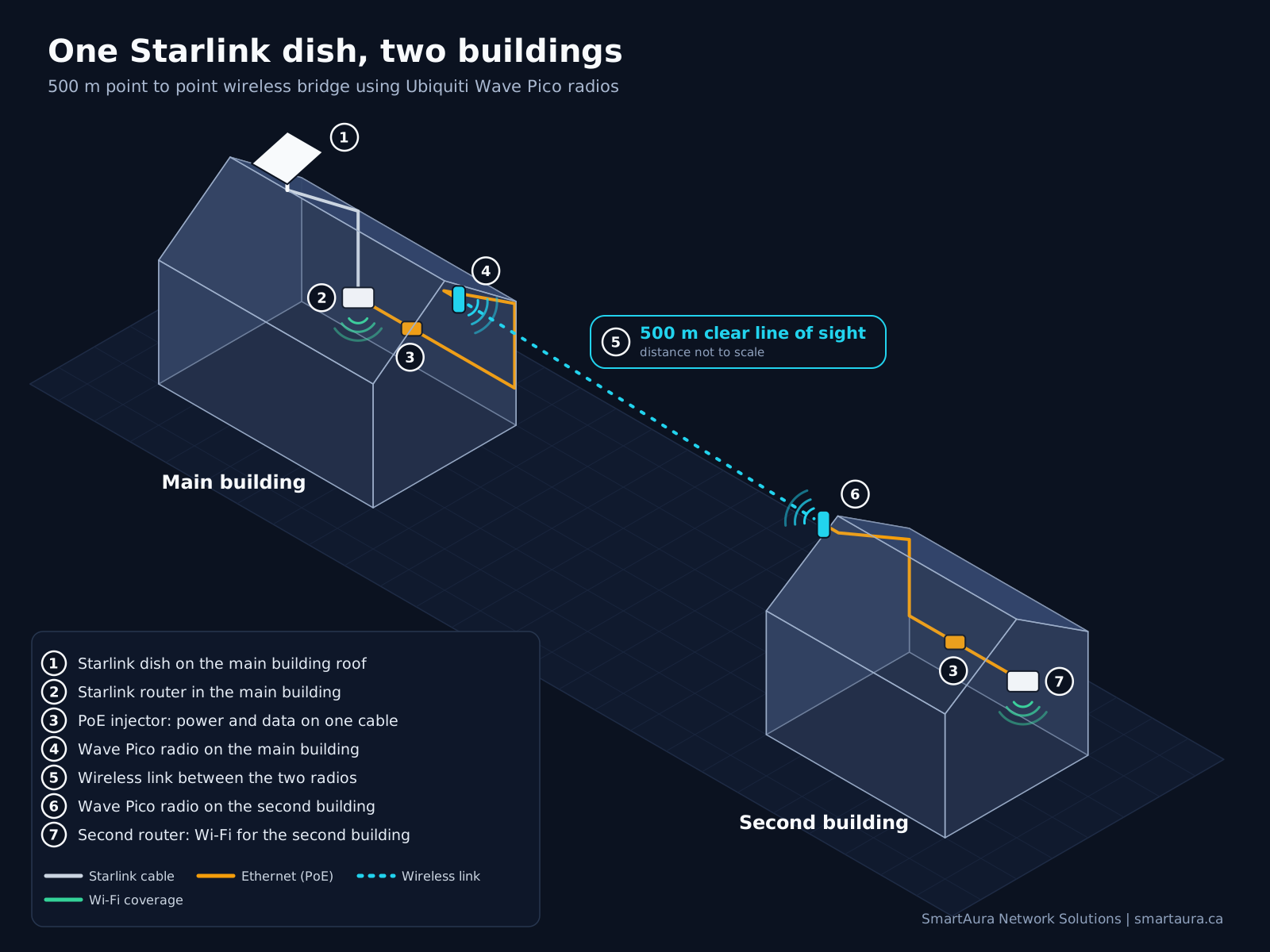
How the two buildings are connected. The distance is not drawn to scale.
What It Costs
Every property is different, so these jobs are quoted after a site visit. The distance, what is in the ground between the buildings, and what the far building is made of all change the answer.
Related Questions
How far can Ethernet run between buildings?
Up to 100 metres per run. Past that, use fibre or a wireless bridge.
Will a wireless bridge work through trees?
Poorly. A few bare branches may be fine in winter, but summer leaves often break the link. Clear line of sight is the rule.
How do I get Wi-Fi inside a metal building?
Bring the internet to the building by cable or bridge, then put an access point inside. Wi-Fi from outside will not get through steel.
Can my Starlink router be in my garage?
Yes, if the garage is dry, has power, and the dish cable reaches. The house can then be fed from the garage.
Get Every Building Connected
If your Starlink works in the house and nowhere else, we can fix that. SmartAura designs and installs links between buildings across Caledon, Orangeville, Erin, and Dufferin and Wellington County. Our rural Starlink installation guide covers the dish side of the job.
Request a quote or call (647) 247-8864, Monday to Friday, 8 AM to 5 PM. See our Starlink installation service for what a full install includes.